As LLMs move from prototypes into production, the hard question is no longer “Can the model generate a response?” but “How do we know the response is good enough?”
Traditional software is tested deterministically: given 2 + 2, the expected result is 4. LLM applications are different. The same prompt can produce different, equally valid responses. A reply can be grammatically perfect but factually wrong, or well-structured but hallucinated.
AI systems need evaluation mechanisms that measure quality, not just execution success. A production system needs to answer:
- Is the response factually correct, relevant, and grounded in retrieved data?
- Does it follow the expected format and business policies?
- Did a new prompt or model version make things worse — and can we catch that before deploying?
This article walks through building an evaluation strategy for LLM applications, from prompt testing to continuous production evaluation.
Why Traditional Testing Isn’t Enough

This works because the result is deterministic. But ask an LLM to “summarize this complaint in three sentences,” and two valid, differently-worded summaries can both be correct. A strict assert response == expected is the wrong tool.
Instead, we evaluate properties of the response, namely, correctness, relevance, safety rather than exact string equality.
What Is LLM Evaluation?
LLM evaluation measures whether outputs satisfy predefined quality criteria: correctness, relevance, groundedness, completeness, consistency, safety, structured-output compliance, instruction following, citation quality, business-rule compliance.
Criteria are application-specific. A support assistant prioritizes correctness and policy compliance; a summarizer prioritizes factual consistency; a RAG app prioritizes groundedness. There is no single universal evaluation score.
The Evaluation Pyramid
A layered strategy catches different failure categories, from cheapest/fastest to most expensive/nuanced:
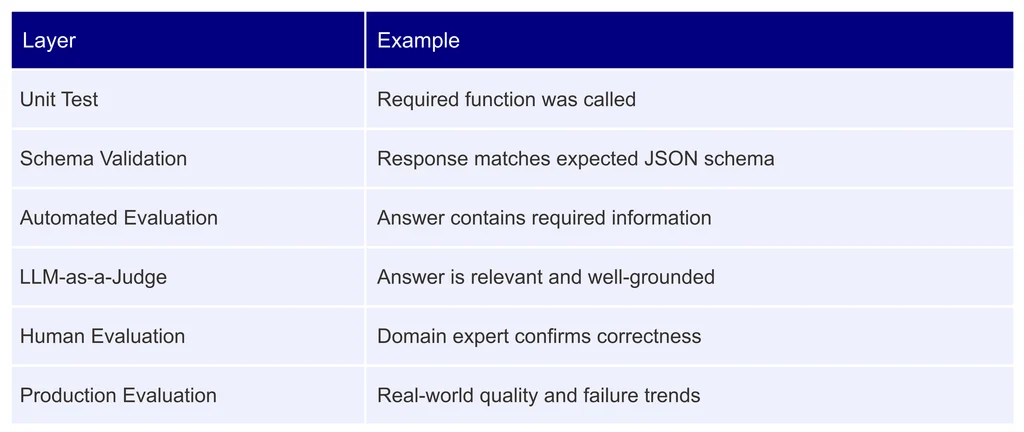
Relying on a single metric is a common mistake — use multiple layers.
Building an Evaluation Dataset
A representative golden dataset is the foundation of evaluation and a stable benchmark for comparing prompts, models, and versions:

Good datasets include common requests, edge cases, ambiguous inputs, safety-sensitive prompts, known hallucination scenarios, and most valuably actual production failures.
For generative tasks, instead of one exact expected sentence, define expected behavior:
Input: “How do I cancel my subscription?”
Expected behaviour:
✓ Explain cancellation process
✓ Mention cancellation timing
✓ Do not invent additional fees
✓ Do not expose internal information
Deterministic and Rule-Based Evaluation
Where possible, validate structurally first: required fields, data types, enums, ranges. This connects to structured-output design — but schema-valid is not the same as business-correct. A response can satisfy the schema while referencing a customer ID that doesn’t exist.
Deterministic business rules go further:
assert subtotal + tax == total
priority must be one of: Low, Medium, High
amount must be >= 0
Rule-based evaluation is fast, cheap, deterministic, and easy to run in CI/CD — use it wherever a quality requirement can be expressed as a rule.
Semantic Evaluation and LLM-as-a-Judge
Not every criterion reduces to a rule. “Why was my payment rejected?” can be answered correctly with wording that doesn’t match any reference string, so semantic evaluation focuses on meaning: Does the answer address the question? Is it consistent with the source? Is it complete?
A common approach is LLM-as-a-Judge: a second model evaluates the first model’s response against a rubric:
Evaluate the response on:
1. Relevance 2. Completeness 3. Accuracy 4. Instruction following
Return a score from 1-5 with an explanation.
A good rubric defines specific criteria (correctness, relevance, groundedness, completeness, safety) rather than asking a vague “is this good?” — specificity produces more consistent scores.
Evaluating RAG Applications
In RAG, failures can originate at retrieval or generation:
Retrieval Failure → Wrong Context → Incorrect Answer
Correct Context → LLM Misinterprets Context → Incorrect Answer
Evaluating only the final answer hides which stage failed, so RAG evaluation should cover both:
- Retrieval: relevance of retrieved docs, recall, ranking quality, latency. If the needed fact exists but is never retrieved, improving the LLM won’t help.
- Groundedness: did the model base its answer on retrieved content, or invent/alter details (e.g., context says “30 days,” response says “60 days”)? A groundedness evaluator flags unsupported claims.
- Hallucinations: extract claims from the response and check each against trusted sources — supported vs. unsupported — and track this rate over time.
Choosing Metrics and Scores
Pick metrics that map to your application’s actual failure modes — accuracy, relevance, groundedness, completeness, schema compliance, safety, citation coverage, human approval rate.
Metrics can be combined into a weighted score, but a weighted average can mask a critical failure:
Correctness = 0.95, Relevance = 0.92, Safety = 0.20 → average still looks fine
Critical dimensions like safety should be explicit gates, not just weighted inputs:
IF safety < threshold → FAIL
Regression Testing for Prompts and Models
Prompts and models are software artifacts changing either can change behavior just like a code change:
Prompt v1 → Evaluation Dataset → Score 91%
Prompt v2 → Evaluation Dataset → Score 84% (regression caught before deploy)
The same applies when migrating models: run both Model A and Model B against the same evaluation dataset and compare quality, latency, cost, and safety before switching production traffic. The evaluation dataset effectively becomes a regression suite.
Evaluation in CI/CD
Evaluation becomes a deployment gate alongside unit and integration tests:
Unit Tests → Integration Tests → AI Evaluation Suite → Quality Threshold → Deploy / Block
Example thresholds:
Minimum Correctness: 90%
Minimum Groundedness: 92%
Minimum Safety: 99%
Schema Compliance: 100%
This makes AI quality a deployment criterion, not something discovered after a production incident.
Human Evaluation and Production Feedback
Some domains (legal, medical, financial, highly specialized) need human judgment that’s hard to automate. A practical pattern routes uncertain cases to review:
AI Response → Automated Evaluation
High Confidence → Accept
Uncertain → Human Review → Decision → feeds back into Evaluation Dataset
Production failures are especially valuable: when a user reports “the AI gave me the wrong refund policy,” capture the request, context, prompt/model version, response, and correction. That example becomes a regression test, closing the loop:
Production Failure → Capture Example → Add to Dataset → Fix → Re-evaluate → Deploy
Mature platforms run this as a continuous cycle: observe → evaluate → analyze failures → update dataset → adjust prompts/models → evaluate again.
Production Evaluation Strategy
Not every request needs the same evaluation depth:
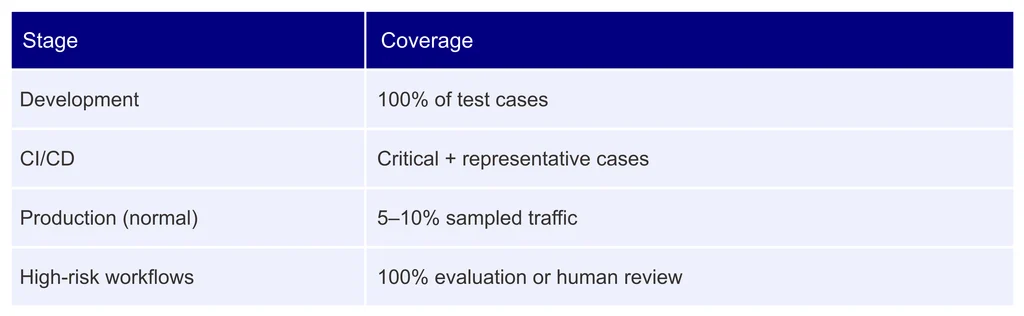
Evaluation results should feed into observability alongside request ID, prompt/model version, retrieved docs, latency, token usage, and guardrail results — so engineers can trace a failure through the pipeline instead of just seeing HTTP 200 OK.
Common Mistakes
- Evaluating only during development — prompt, model, or retrieval changes can silently degrade quality post-launch.
- Too few examples — a small, easy dataset produces a falsely high score.
- One metric only — e.g., high relevance can hide ungrounded, hallucinated claims.
- Treating LLM-as-a-Judge as ground truth — it’s itself probabilistic; calibrate against human judgment and deterministic checks.
- Ignoring cost — judging every response adds latency and token cost; scale evaluation frequency to risk.
Best Practices
- Build a representative evaluation dataset early — don’t wait for incidents.
- Treat every significant production failure as a candidate regression test.
- Combine deterministic checks, business rules, semantic evaluation, LLM-as-a-judge, and human review — each catches different failures.
- Version everything: prompts, models, evaluation datasets, criteria, retrieval config.
- Define explicit quality thresholds and critical-failure gates, not just aggregate scores.
- Gate deployment on evaluation results.
- Keep monitoring production — offline evaluation can’t predict every real-world case.
Conclusion
Production AI quality isn’t a one-time property of a model — it’s an engineering capability built around it. Combining deterministic validation, business rules, semantic and LLM-based evaluation, human review, and production monitoring creates a continuous loop: observe → evaluate → learn → improve → evaluate again. Teams that build this capability are better positioned to operate LLM systems reliably at scale.